How do you know a diamond is ethical when the industry is filled with misleading claims?
Introduction
Modern diamond consumers are increasingly cautious; nonetheless, uncovering the truthfulness of an ethical diamond proves to be quite challenging. The industry is overflowing with broad claims, ambiguous certifications, and marketing terminology that appears credible yet frequently conceals significant truths. For numerous consumers, it becomes quite challenging to ascertain whether a diamond was sourced ethically or merely labelled as such.
If you have ever wondered how to separate genuine ethics from misleading claims, you’re not alone. This blog uncovers why ethical sourcing is so complex, what the most common misconceptions are, and what it truly takes for a diamond to meet real ethical standards.
Conflict-free diamonds & the Kimberly process.
For numerous people, the phrase “conflict-free” appears to guarantee responsible sourcing. It specifically indicates a diamond that has not been used to finance armed groups. This definition originates from the Kimber Process, an international certification framework instituted in 2003 to obstruct the entry of conflict diamonds into the global market. This strategy has substantially reduced the traffic in diamonds financed by rebels.
However, the Kimberly Process covers only a small part of what modern consumers consider ‘ethical’. It does not address working conditions, fair wages, environmental impact, or whether local communities benefit from mining activities. As a result, a diamond can be certified as conflict-free and still come from a region where miners face difficult circumstances or where transparency is limited.
This creates uncertainty for consumers seeking to make informed decisions. Recognising that ‘conflict-free” serves as a foundational standard. Recognizing that “conflict-free” serves as a foundational standard, rather than a comprehensive ethical assurance, is a crucial initial step. Genuine ethical sourcing requires additional care, openness, and responsibility from companies that want to offer more than the industry minimum.
Fair Labor & Human Rights
Ethical diamond sourcing is not only about avoiding conflict, but also about the people behind every stone. Numerous consumers presume that a “conflict-free” label ensures equal treatment of workers. However, this is not accurate. Equitable labor extends well beyond the mere absence of funding violence. It includes safe working environments, fair wages, respect for local communities, and the absence of exploitation such as child labor or forced labor. Unfortunately, these aspects are not covered by the Kimberly Process, indicating that a diamond may be deemed “conflict-free” while yet originating from a mine where labourers endure challenging or hazardous conditions.
For consumers who care about ethics, this gap can be confusing. The reality is that true human rights protection requires more than certification alone. It depends on the commitment of the companies involved, specifically their alertness in monitoring working conditions, selecting ethical partners, and upholding dignity along the supply chain. Fair labor is therefore a core part of what ethical sourcing should mean today: ensuring that the beauty of a diamond is never overshadowed by harm to the people who make its existence possible.
Traceability and transparency
One of the biggest challenges in the diamond industry is the absence of transparent, dependable information regarding the true origin of a diamond. Numerous brands make ethical claims, but without transparency, buyers have little way to verify them. Traceability is therefore becoming one of the most important elements of ethical diamond sourcing. It means being able to follow a diamond’s journey from the mine to the final polished gemstone, accompanied by documentation that verifies each stage was conducted ethically.
For modern consumers, this degree of transparency is no longer a luxury but an expectation. People want to know who mined their diamond, under what conditions it was handled, and how it arrived in the hands of their jeweller. Transparency offers assurance, mitigates the likelihood of deceptive claims, and enables purchasers to make informed and assured decisions. When a company can demonstrate full traceability, it shows accountability and honesty. These are essential in an industry where so much happens behind the scenes.
Royal Coster Diamonds goes above and beyond
At Royal Coster Diamonds, ethical sourcing is not an optional promise; it is the foundation of everything we do. Unlike many organisations that adhere just to basic industry requirements, we exclusively utilise ethically sourced, fully traceable natural diamonds, verified by the leading certification institutes: GIA, IGI, and HRD. These institutes examine significantly more than the technical quality of a diamond. They meticulously track the origins of each stone, validate ethical sourcing methods, and guarantee that its origin and authenticity can be properly verified. By collaborating with firms that continuously surpass minimum standards, we incorporate their superior benchmarks as our own.
Our commitment goes further than compliance. We combine our centuries-old craftsmanship with modern values such as transparency, sustainability, and respect for both people and the planet. For us, ethical sourcing is not just a responsibility, but a tradition. By selecting partners who emphasize integrity and accountability, we guarantee that each diamond we provide embodies not just brilliance, but also ethical transparency.
How Royal Coster Diamonds combines traditional with modern standards
Royal Coster diamonds carries a long tradition of craftsmanship, developed over more than 185 years of working with some of the world’s most exceptional diamonds. This legacy is founded on precision, care, and a deep understanding of the responsibility that comes with working in a field so closely connected to both culture and nature. Currently, these traditional values align with the ethical standards of a modern industry. Consumers increasingly expect clarity, sustainability, and respect for the people involved in the supply chain.
To meet these expectations, RCD incorporates modern ethical frameworks into its historic working methods. Through collaborating with recognized global institutions such as GIA, IGI, and HRD, we guarantee that each natural diamond is ethical. These institutes implement strict verification procedures that reflect the accuracy standards we have maintained for generations. By combining the reliability of established craftsmanship with the transparency and accountability demanded today, RCD ensures that its diamonds reflect both responsible sourcing and the refined standards of its long-standing tradition.
How this supports local communities and workers
Supporting those involved in the diamond sector is an important part of responsible sourcing. Through our collaboration with GIA, IGI, and HRD, we contribute to systems that help strengthen skills, protect workers, and support local economies. GIA contributes to global education by providing professional training and scholarships, particularly in areas with restricted access to specialised education. By establishing grading criteria, such as the 4C’s, and fostering ethical consciousness, they enhance transparency and equitable possibilities for both workers and consumers.
IGI supports employment and skill development through its international network of laboratories, where local staff receive training in gemmology and grading. This creates accessible employment possibilities and enables smaller companies to engage in an industry that prioritizes certified expertise. HRD Antwerp contributes to the stability of the Belgian diamond industry by providing training programs, supporting local businesses, and working with regulators to encourage ethical and transparent business.
By working with organisations that invest in education, fairness, and responsible industry development, Royal Coster Diamonds supports a supply chain in which workers and communities can benefit from long-term opportunities rather than short-term extraction.
Ethical craftsmanship at RCD
Ethical sourcing does not end once a diamond leaves the mine. The cutting and polishing steps are equally important, as these processes rely on skilled specialists whose working conditions, expertise, and craftsmanship determine the ulti
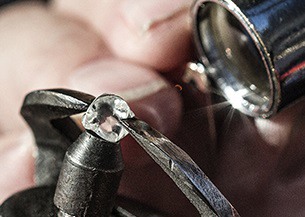
mate quality of each stone. Royal Coster Diamonds acknowledges the duty that comes with this part of the value chain. Our craftsmen and women work in a professional setting where precision and care are central, supported by safe working conditions and access to specialised training. This ensures that the expertise behind each polished diamond is respected and maintained to the utmost quality.
Ethical craftsmanship also means working transparently and honouring those involved in the transformation of a diamond to its final form. By investing in proper tools, training, and responsible workshop practices, we uphold the same values in our polishing rooms and guide our sourcing decisions. By doing so, we guarantee that the beauty of each finished diamond reflects not only the technical excellence, but also the integrity and respect with which it was crafted.
Why responsible buyers should choose RCD
For today’s responsible buyers, choosing a diamond is about more than beauty alone; it is about trusting the values behind the stone. Royal Coster Diamonds offers this reassurance by combining ethical sourcing, transparent verification, and refined craftsmanship. Through our collaboration with leading certification institutes and our commitment to responsible practices across the entire value chain, we ensure that each diamond reflects both integrity and excellence. This allows buyers to make a choice that aligns not only with their aesthetic preferences but also with their ethical standards.